Article
Contents · 8 sections
A letter for a man in hospital
The letter from the bank, which arrived in the second week of September, was routine. Bhima Medisupply's ₹20 crore working-capital limit was due for renewal, and the relationship manager in Pune wanted the managing director's signature on the papers by the end of October.
The managing director, Dilip Chitnis, had been in hospital since 11 August after heart surgery and would not be back at his desk for eleven weeks. His son Aniket signed what the company's resolutions allowed. Rekha Pawar, the head of collections, signed nothing, but she was the one the manager asked about something else: why customers had started paying so slowly.
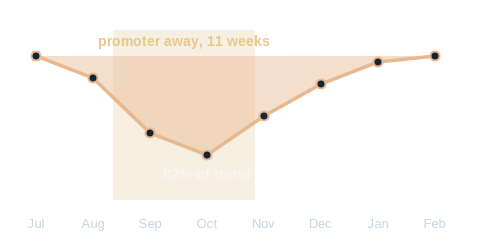
Debtor days, the average number of days customers take to pay, had sat between 40 and 42 for three years. At the end of September they read 49, and at the end of October 58. Bhima is a pharmaceutical wholesaler selling about ₹300 crore a year at an 8% gross margin, which leaves about ₹2 crore a month after paying manufacturers for the stock. October's gross profit came in 18% below trend.
Figure 1 · Illustration
Customers took longer to pay while the promoter was away
Debtor days at month end
View as a table
| Month | Gross profit against trend | Debtor days |
|---|---|---|
| Jul | 0% | 41 |
| Aug | −4% | 42 |
| Sep | −14% | 49 |
| Oct | −18% | 58 |
| Nov | −11% | 53 |
| Dec | −5% | 47 |
| Jan | −1% | 44 |
| Feb | 0% | 42 |
The books record the slowdown without explaining it. Credit limits for the chemists had always been settled by Dilip on a telephone call. Rekha's team did not know which late payers he tolerated and which he chased, and a clerk put a Kothrud chemist who had paid on about the forty-fifth day for twenty years on stop-supply. The chemist ordered from another wholesaler the same week. The regional representatives of two manufacturers asked who could agree the quarter's trade schemes, and nobody could say.
Dilip, who is 63, is now weighing a sale to a larger distribution group against handing the company to Aniket, who is 32. This article does not choose between the two. It shows how to value the company under three different futures, and the sixth section says which future each route resembles.
Everything about Bhima Medisupply, from the Chitnis household to the last line of the debtor ledger, was composed for this article and records no actual wholesaler.
What a market salary buys
A valuer deals with a promoter-run company in two stages. The first is normalisation: restating profit as it would look under ordinary arrangements, so that it can be compared with other businesses or used as a base for forecasts. The profit measure used here is EBITDA, earnings before interest, tax, depreciation and amortisation. The series article on reading one set of accounts covers the mechanics. For Bhima it turns reported EBITDA of ₹12.0 crore into ₹11.0 crore: Dilip's ₹0.6 crore of pay is raised to about ₹2.2 crore, the cost of someone able to run a ₹300 crore wholesaler (a deduction of ₹1.6 crore), and family costs that are not for work done come out (an addition of ₹0.6 crore). The resulting margin, about 4% of sales, is generous for a wholesaler; the argument rests on ratios and does not depend on it.
The second stage is the subject of this article. A professional at ₹2.2 crore buys the work Dilip does. It does not buy what the eleven weeks exposed: that some eight hundred customers pay promptly, and manufacturers extend terms, partly because they know him. A salary buys the labour. The thirty years of being known were never on the payroll.
So the normalised ₹11.0 crore is what the business earns if that trust transfers intact. Whether it does has to be answered inside the cash flows. The series article on what makes a business valuable beyond its financial statements treats relationships and management as sources of value. The question here is narrower: how much of the stated earnings leaves with one named person, and how quickly does the business get it back?
Reading the books for the absence
Dilip's absence was an accident, but it works as an experiment. For eleven weeks the company ran without the one person on whom everyone says it depends, and the books recorded the result. That is different evidence from a key-person questionnaire, because it was produced by customers and suppliers who had no reason to be polite. Four numbers carry the model.
The first-year loss. What share of normalised EBITDA goes in the first year after a change? In October the shortfall was 18% of gross profit, which annualises to ₹4.3 crore, or 39% of ₹11.0 crore, because the rest of the cost base did not shrink. The whole episode cost much less, about ₹1.06 crore or 10% of a year's EBITDA, because Dilip came back. We take 35% for a permanent departure. That is a stated stress between the 10% the episode actually cost and the 39% October trough, not a measurement, and the owner should replace it with a reading from their own records; the sensitivity grid in the fifth section shows 25% and 45% as well. The evidence pulls both ways. Customers who knew he was returning had a reason to wait, so a permanent exit could be worse than the episode suggests. October on its own, annualised, probably overstates an average year.
The years to recover. Within about four months of his return, gross profit was back to trend. That speed belongs to Dilip, whom customers already trusted. A successor starts without thirty years of credit. We allow four years, in equal steps back to the lasting level. Nothing in the episode measures this, and it is the least certain input in the model.
The lasting loss. Some customers, and some scheme income from manufacturers, do not return. We assume 5% of normalised EBITDA, permanently.
The transition cost. Hiring a head of credit control and a sales head who overlap with the existing team, and writing down the credit rules that live in Dilip's head, costs about ₹1.2 crore a year before tax for three years. This is separate from the ₹2.2 crore for the role, which already includes whatever Dilip is paid while he stays on.
Table 1 shows where each number comes from in the business.
| What Dilip does | What the records showed | What it moves |
|---|---|---|
| Sets credit limits and tolerates late payers by feel | Debtor days 41 to 58; bad-debt provision rose | First-year loss; years to recover |
| Agrees trade schemes and credit terms with manufacturers | Scheme income lower for two quarters | Lasting loss |
| Introduced the hospital and institutional accounts | Several accounts split their orders | First-year loss |
| Guarantees the bank limits personally | Not tested by the episode | Outside the model (below) |
| Is the only person who knows all of this | Staff could not say who decided | Years to recover |
Table 1. Where a promoter sits in the cash flows of a distribution company. The right-hand column is the model input that carries the effect.
Two things the eleven weeks showed are not priced in the model. The first is the bank. Dilip guarantees the working-capital limit personally, a lender renewing ₹20 crore will ask who stands behind it, and a buyer will ask for the guarantee to be released at closing. The second is working capital. Debtor days at 58 instead of 41 meant about ₹14 crore more owed by customers, equal to 70% of the borrowings. At an assumed borrowing cost of 11% that is about ₹1.5 crore a year before tax for as long as it lasts, a one-off if customers catch up and a lasting drag if they do not. Either would add to the losses shown below, so the figures understate the cost of an abrupt exit in this respect.
If there is no eleven-week absence in your books. Most owners have not had one. The nearest substitutes are in records already kept: a month the promoter was travelling; a branch or product line he does not run, compared with those he does; the accounts of a salesman who left, and how long they took to settle; sales split by who holds the relationship. Read debtor days, the order book and gross margin across each. None is as clean as an absence, so treat the result as a range, not a point.
Three futures for one company
The model compares three futures for the same company. In the first the promoter stays and earns the normalised ₹11.0 crore, growing with the business. In the second he leaves abruptly. In the third the hand-over is planned: he stays for three years as chairman, the successor sits in on every principal negotiation, and the credit rules are written down. Table 2 gives the inputs. The planned case cuts the first-year loss from 35% to 15%, shortens recovery from four years to three, cuts the lasting loss from 5% to 3%, and costs less in transition spending. All of these are assumptions, and the shortened recovery is the one to doubt most.
| Promoter stays | Planned hand-over | Abrupt exit | |
|---|---|---|---|
| First-year loss of normalised EBITDA | 0% | 15% | 35% |
| Years to recover | – | 3 | 4 |
| Lasting loss | 0% | 3% | 5% |
| Transition cost, ₹ crore a year for 3 years | 0.0 | 0.8 | 1.2 |
Table 2. Inputs for the three futures, all assumed for illustration.
Figure 2 · Illustration
The same company, two ways of letting go
View as a table
| Year | Abrupt exit, % kept | Planned hand-over, % kept |
|---|---|---|
| 1 | 65.0 | 85.0 |
| 2 | 72.5 | 89.0 |
| 3 | 80.0 | 93.0 |
| 4 | 87.5 | 97.0 |
| 5 | 95.0 | 97.0 |
| 6 | 95.0 | 97.0 |
| 7 | 95.0 | 97.0 |
| 8 | 95.0 | 97.0 |
| 9 | 95.0 | 97.0 |
| 10 | 95.0 | 97.0 |
Value here is the present value, meaning what future cash is worth today, of free cash flow: operating profit after tax less what the business must reinvest to grow. The discount rate is an assumed cost of capital of 13%. Cash flows fall at the end of each year, tax is 25%, and profit grows at 6% for ten years and then 5%. Reinvestment is a fixed share of each year's profit, so lost profit also lowers reinvestment. The remaining assumptions are in the technical notes. Enterprise value, the value of the operations before deducting debt, is then ₹60.1 crore if the promoter stays. That is 5.5 times normalised EBITDA, an output of the assumptions and not a market multiple.
Figure 3 · Illustration
Where the lost value comes from
- Relationships rebuilt over time (temporary part)
- Transition costs
- Lasting loss
View as a table
| Case | Relationships rebuilt (₹ crore lost) | Transition costs | Lasting loss | Enterprise value | Equity value |
|---|---|---|---|---|---|
| Promoter stays | 0.0 | 0.0 | 0.0 | 60.1 | 38.1 |
| Planned hand-over | 1.1 | 1.4 | 2.2 | 55.4 | 33.4 |
| Abrupt exit | 3.3 | 2.1 | 3.7 | 51.1 | 29.1 |
An abrupt exit takes about 15% off enterprise value and a planned hand-over about 8%. Neither is mostly about relationships being rebuilt. In the abrupt case the largest part, about two-fifths, is the lasting loss: the earnings that never return. Rebuilding accounts for a little over a third and the changeover costs for the rest. In the planned case the lasting loss is almost half. The permanent 5% matters more than the four-year climb back. The difference between the two routes, ₹4.4 crore, is what preparing is worth: about 0.4 of a year's normalised EBITDA.
Borrowings amplify the effect, as Table 3 shows. Net debt here is bank borrowings of ₹20.0 crore plus a ₹4.0 crore loan from Dilip to the company, which a buyer would treat as debt-like, less ₹2.0 crore of cash: ₹22.0 crore. The family also receives the ₹4.0 crore back, so the equity is what moves.
| ₹ crore | Promoter stays | Planned hand-over | Abrupt exit |
|---|---|---|---|
| Value lost: relationships rebuilt | 0.0 | 1.1 | 3.3 |
| Value lost: transition costs | 0.0 | 1.4 | 2.1 |
| Value lost: lasting loss | 0.0 | 2.2 | 3.7 |
| Enterprise value | 60.1 | 55.4 | 51.1 |
| Net debt | −22.0 | −22.0 | −22.0 |
| Equity value | 38.1 | 33.4 | 29.1 |
| Equity value lost against "stays" | 12% | 24% |
Table 3. Components are rounded to one decimal place. 1.1 + 1.4 + 2.2 = 4.7, and 60.1 − 4.7 = 55.4. For the abrupt case, 3.3 + 2.1 + 3.7 = 9.1, but 60.1 − 9.1 gives 51.0 where 51.1 is shown, because the unrounded figures are 60.13 − 9.07 = 51.06. Likewise 55.4 − 51.1 gives 4.3 where 4.4 is quoted (unrounded 55.44 − 51.06 = 4.38). "Relationships rebuilt" is the temporary part of the loss; "lasting loss" is the permanent part in every year, including after year ten.
Why one percentage hides the argument
Some advisers value a promoter-dependent business by taking a flat discount for "key-person risk" off the value. Others add a company-specific premium to the discount rate. No percentage of either kind has been used here, and none is claimed as observed. Each squeezes the whole story into one number. For scale, on the promoter-stays cash flows the rate that reproduces the abrupt-exit value is 14.3%, a premium of 1.3 points over 13%, and 0.6 of a point reproduces the planned case. Neither premium says when the loss falls or whether it comes back.
Figure 4 varies the first-year loss and the years to recover, leaving everything else as it was in the abrupt case.
Figure 4 · Illustration
How much enterprise value goes, by depth and by duration
| First-year loss; years to recover | 2 yrs | 4 yrs | 6 yrs | 8 yrs |
|---|---|---|---|---|
| 15% lost in year 1 | 10.8% | 11.5% | 12.1% | 12.7% |
| 25% lost in year 1 | 11.9% | 13.3% | 14.5% | 15.7% |
| 35% lost in year 1 | 13.0% | 15.1% | 17.0% | 18.7% |
| 45% lost in year 1 | 14.2% | 16.9% | 19.4% | 21.7% |
Rows: share of earnings lost in year 1. Columns: years taken to recover (yrs).
Look at two cells. A first-year loss of 45% with recovery in two years costs 14.2% of enterprise value. A first-year loss of 25% with recovery in six years costs 14.5%. The percentages are almost the same. The businesses are not. The first has a cliff, which a prepared hand-over, a retained promoter or a payment tied to later performance can bridge. The second has a slope: the successor may be slow to rebuild trust, or the trade may simply change suppliers slowly. Preparation may reduce that duration, but cannot be assumed to remove a structural delay in how the trade changes suppliers. The planned case shortens recovery from four years to three; that one-year gain is an explicit assumption to test, not a promise made by the model. A flat percentage would prescribe the same remedy for both.
Depth and duration are worth about the same. Stretching recovery from four years to eight at a 35% first-year loss adds about 3.6 points of lost value (15.1% to 18.7%). Cutting the first-year loss from 35% to 15% at four years takes off about 3.6 points (15.1% to 11.5%). Depth is the easier of the two for a promoter to reduce before he leaves. Duration depends more on the trade and on the successor.
Sale or succession: which future is each?
Dilip's two routes are not two valuations. Each is a guess at which of the three futures follows.
Handing over to Aniket resembles the planned case if it starts now. Aniket already runs the warehouse and the systems, but not yet the chemists' credit decisions or the manufacturers' negotiations, and Dilip would have to stay on and let him make the calls. Aniket's inputs may be gentler in the first year, because the trade knows him, and harsher later, if he lacks the standing to refuse an old friend's late payment.
A sale to the larger group resembles the abrupt case unless Dilip stays through a transition on terms the buyer will pay for. The group may lose less in the first year, because it has its own credit systems and manufacturer relationships. That gain belongs to that buyer. It is investment value, the value to a specific buyer, and not standalone value, and whether the price shares it with Dilip is a matter of negotiation. The series article on a shareholder's exit takes up the interest sold and the terms. A buyer will also ask Dilip not to compete after the sale. Under section 27 of the Indian Contract Act, 1872 he can promise that only as part of selling goodwill, within reasonable local limits, so it protects the goodwill actually sold and no more. The buyer will also want his guarantee of the bank limits released at closing, and his ₹4.0 crore loan repaid.
Try your own numbers
The calculator below runs the same model. Put in your own normalised EBITDA, the loss you read from your own records and the speed of recovery you believe, and compare an abrupt exit with a prepared one.
Calculator
What does a change of hands cost this business?
The defaults are the Bhima Medisupply figures from this article. Replace them with your own business and with your own reading of how much earnings depend on the promoter. Everything is in ₹ crore with year-end cash flows. It is an educational model, not a valuation.
Result
- Value of preparing the hand-over
- ₹4.4 crore
- Enterprise value, promoter stays
- ₹60.1 crore
- Enterprise value, abrupt exit
- ₹51.1 crore
- Enterprise value, planned
- ₹55.4 crore
- Equity value, ₹ crore: stays / planned / abrupt
- 38.1 / 33.4 / 29.1
- Equity value lost: planned / abrupt
- 12.3% / 23.8%
Enterprise value falls by 15.1% after an abrupt exit and by 7.8% after a planned hand-over.
Earnings kept, year by year
| Year | Abrupt exit, % kept | Planned hand-over, % kept |
|---|---|---|
| 1 | 65.0 | 85.0 |
| 2 | 72.5 | 89.0 |
| 3 | 80.0 | 93.0 |
| 4 | 87.5 | 97.0 |
| 5 | 95.0 | 97.0 |
| 6 | 95.0 | 97.0 |
| 7 | 95.0 | 97.0 |
| 8 | 95.0 | 97.0 |
| 9 | 95.0 | 97.0 |
| 10 | 95.0 | 97.0 |
Percentage of normalised EBITDA kept. Transition costs are separate and come on top. Enterprise value is the sum of ten years of free cash flow and a terminal value, discounted at the cost of capital.
A quarter on purpose
The eleven weeks were an accident, and they gave Dilip a measurement he could not have bought. He can repeat it deliberately. For one quarter, with Dilip reachable but not asked, Aniket and Rekha approve the credit limits and agree the manufacturers' schemes, and the books record debtor days, orders and gross profit as they stood in July.
A quarter that looks like July suggests the planned case is within reach. A quarter that looks like October says the 15% first-year loss has not been earned yet, and any price for the company should be read with the 35% in mind. The test has a cost of its own, since a customer who is let down in the quarter may not return, so it is best run on the accounts Dilip knows to be safe.
Talking it through
If a valuation question is in front of you, a conversation about purpose, scope and the information needed is usually the right first step.
Technical notes
- All amounts are in ₹ crore unless stated. Sales ₹300 crore, gross margin 8%, EBITDA margin about 4% (reported ₹12.0 crore, normalised ₹11.0 crore), depreciation ₹2.0 crore, tax 25% on operating profit, cost of capital 13%, growth of operating profit after tax 6% for ten years and 5% afterwards, a 15% return on new capital and net debt of ₹22.0 crore are assumed for illustration. They are not market observations. The 8% gross margin is a round figure not checked against trade data, and an EBITDA margin of about 4% is at the generous end for a wholesaler with its own godown and delivery; the model works on ratios, so the conclusions do not depend on the scale.
- Normalisation: ₹12.0 crore less ₹1.6 crore (promoter's pay of ₹0.6 crore raised to ₹2.2 crore for the role) plus ₹0.6 crore (family costs that are not for work done, net) gives ₹11.0 crore. The adjustments are assumed.
- The absence episode (monthly shortfalls of 4%, 14%, 18%, 11%, 5% and 1% below trend gross profit, and debtor days of 41, 42, 49, 58, 53, 47, 44 and 42) is made up. Its total cost was about ₹1.06 crore, 9.6% of a year's normalised EBITDA. October alone, annualised, is 39% of normalised EBITDA. The 35% first-year loss for a permanent exit is a stressed judgement between those readings. The years to recover, the lasting loss and the transition costs have no measurement behind them and are the least certain inputs.
- Enterprise value is ten years of free cash flow plus a terminal value, with year-end cash flows. Lost earnings are measured on EBITDA, taxed at 25%, and grow with the business. Reinvestment is growth divided by the return on new capital, applied to each year's operating profit before transition costs, so lost profit also lowers reinvestment (about 60% of lost operating profit becomes lost free cash flow in years 1 to 10). Transition costs are cash costs taken in full for three years and include whatever the promoter is paid while he stays on.
- Not modelled: extra working capital funded while customers pay more slowly (about ₹14 crore at the October peak; about ₹1.5 crore a year before tax at an assumed 11% borrowing cost), the cost of replacing the promoter's personal guarantee of the bank limits, and any change in lenders' terms. All three would add to the loss shown, so the model understates the cost of an abrupt exit in these respects. The model also ignores any buyer-specific synergy.
- The rate premium quoted in the text (14.3% against 13%, about 1.3 points) is the discount rate that, applied to the promoter-stays cash flows, gives the abrupt-exit value of ₹51.1 crore; 0.6 of a point does the same for the planned case. They are arithmetic equivalents, not recommended premiums.
- Rounding: figures are shown to one decimal place. 1.1 + 1.4 + 2.2 = 4.7 and 60.1 − 4.7 = 55.4. For the abrupt case 3.3 + 2.1 + 3.7 = 9.1, but 60.1 − 9.1 gives 51.0 where 51.1 is shown (unrounded 60.13 − 9.07 = 51.06). The value of preparing, 4.4, is unrounded 55.44 less 51.06, which is 4.38.
- The model values the business on a standalone basis with an ordinary successor. It does not value any particular shareholding, and it adds no discount or premium for control or marketability.
- This is an educational model, not a valuation report.
References
Checked on 5 November 2026. Cited in general terms only.
- Indian Contract Act, 1872: section 27 and Exception 1 (agreement in restraint of trade; sale of goodwill). Text read from a reproduction; check the India Code copy for the current version. vidhijudicial.com
About this article
This article and its illustrations are for general education. They are not a valuation, a valuation report under any law, or advice on any transaction, tax or regulatory matter.
A valuation for a real decision depends on the facts, the purpose, the date, the applicable law and standards, and the information available. Please seek professional advice before relying on any figure.
Everything about Bhima Medisupply, from the Chitnis household to the last line of the debtor ledger, was composed for this article and records no actual wholesaler.