Article
Contents · 8 sections
Twice inside the plant
Neha Bhargava has been inside the Pithampur plant of Dhruv Corrugated Packaging twice: once as a child, when her father was one of its two founders, and once for the opening of the second corrugating line. She owns a fifth of the company now. In eleven years nobody has asked her a question about its cash: how much the company keeps, where the kept money goes, what the Saxena family's transport firm charges it for hauling finished boxes. What reaches her is ₹61 lakh each March, called a dividend.
Her accountant, asked what her fifth is worth, said ₹37.4 crore, which is a fifth of what a discounted cash flow says all the shares are worth. ₹61 lakh a year on ₹37.4 crore is a yield of 1.6%. Nobody would hold a business for that. Neha suspects that "20% of the value" describes the company and does not describe what she holds. This article tests the suspicion by giving the same fifth four different sets of paperwork.
Dhruv Corrugated, the Saxenas and Neha are constructed for this page, and every rupee figure is an assumption rather than anyone's books.
A fifth of which number
Start with the company. Dhruv makes corrugated boxes for food, pharmaceutical and engineering customers. On next year's forecast it has sales of ₹280 crore, about 420 people on the payroll, and operating profit before depreciation, interest and tax (EBITDA) of ₹42 crore, a margin of 15%. After ₹11 crore of depreciation, ₹3.5 crore of interest on ₹35 crore of net borrowing and tax at 25%, profit after tax is ₹20.6 crore.
What matters to an owner is the cash left after the business has paid for its own growth. Take the profit, subtract the ₹9.6 crore the plant and working capital must absorb to grow 6% a year, add the ₹2.1 crore a lender will extend against that growth, and ₹13.1 crore is left. Call this the distributable cash (the finance term is free cash flow to equity). If it grows at 6% for ever and owners ask 13% a year for the risk, the equity is worth ₹13.1 crore ÷ (13% − 6%), or ₹187.1 crore. Add the ₹35 crore of net debt and the business is worth ₹222.1 crore, 5.3 times EBITDA. Every rate and every business figure here is assumed for illustration, and 13% is a low return to ask of an unlisted company.
A fifth of ₹187.1 crore is ₹37.4 crore. Call that the pro-rata value. It answers a particular question: what is a 20% slice worth if it carries 20% of the distributable cash whenever that cash is paid, and can be sold at that price? The International Valuation Standards (effective 31 January 2025) do not let a valuer skip the question. IVS 200 names the articles of association and shareholder agreements as the documents that define ownership rights (paragraph 90.01) and says the rights of the interest being valued should be considered (paragraph 90.03). Neha's ₹37.4 crore makes three silent assumptions: that the cash reaches her, that it reaches her when the model says, and that someone will pay for the slice at the value of the whole.
Four sets of paperwork
Now give the same 20% four lives. The business, the forecasts and the ₹37.4 crore stay fixed. Only the cap table, and what is written beside it, changes.
Figure 1 · Illustration with invented data
The same 20% under four sets of paperwork
View as a table
| Company | Holders | Written rights |
|---|---|---|
| 1 | Saxena family 56%, Neha 20%, eleven others 24% | Articles only |
| 2 | Saxena family 51%, Neha 20%, fund 29% | Board seat, consent right on related-party contracts, 60% payout floor, tag-along |
| 3 | Mahendra 40%, Neha 20%, Devendra 40% | Articles only; Neha's vote decides |
| 4 | Saxena family 56%, Neha 20%, eleven others 24% | Whole company sold; tag-along or none |
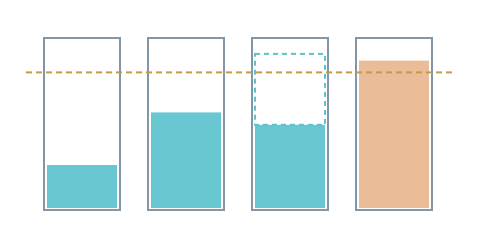
In the first company, the Saxena family holds 56%, Neha 20%, and eleven relatives and long-serving managers share 24%. Nothing exists beyond the articles of association. In the second, the family holds 51%, an investment fund 29%, and Neha has negotiated a shareholders' agreement. In the third, two brothers, Mahendra and Devendra Saxena, hold 40% each, and Neha's 20% sits between them. In the fourth, the family has found a packaging group that wants the whole company, and the only question is what Neha receives.
The rights that make the difference are few, and each touches a specific line of the cash story.
| Right | What it touches | Where it appears below |
|---|---|---|
| Board seat and information | What she can see, and when | Second company; it enables the rest |
| Consent for related-party contracts | Cash leaving through the promoters' other businesses | Second company |
| Minimum payout | When cash reaches her | Second company |
| Tag-along | A share in a sale of control | Fourth company |
| Drag-along | A sale she can be made to join | Fourth company |
Company law adds little to this table. A holder of one-tenth of the capital may petition the Tribunal over oppression or mismanagement (sections 241 and 244 of the Companies Act, 2013), which gives Neha standing to apply; whether she would succeed turns on facts nobody has modelled. And "control" in section 2(27) reaches the right to appoint a majority of the directors or to control management, including through a shareholders' agreement, which is why the paperwork matters.
What reaches a holder who cannot sell
Begin with the first company, where Neha has the least. The Saxenas run the cash. Assume, as an illustration and not as a description of any real family, that the company pays out 25% of its distributable cash, that the retained cash sits in treasury earning 5% after tax, and that the family's transport business charges ₹0.9 crore a year after tax more than an outside carrier would, growing with the company. Nothing in writing gives Neha a way to alter any of this.
The pro-rata value looks at the cash the company has. Neha's claim is on the cash she can reach. Valued as what she would receive if she holds for ever, her fifth is worth ₹12.2 crore, which is 33% of ₹37.4 crore. That is a floor, since it assumes the retained cash is never paid out or realised in a sale. The shortfall has two sources, shown in Figure 2. The transport charge takes ₹2.6 crore of it. The rest, ₹22.6 crore, comes from cash kept back in the company, earning 5% when she would ask 13%.
Figure 2 · Illustration with invented data
Where the first company's gap comes from
View as a table
| Step | ₹ crore |
|---|---|
| Pro-rata value of 20% | 37.4 |
| Less: related-party transport charge | −2.6 |
| Less: cash kept back at 5% when 13% is required | −22.6 |
| Reachable by a holder who never sells | 12.2 |
Taken in the other order, with the payout effect first, the transport charge would account for ₹0.9 crore of the shortfall (a coincidence with the ₹0.9 crore a year charged) and the payout for ₹24.3 crore. The split between the two depends on the order, so Figure 2 shows the total fall, and the pieces are not separate prices.
The second source looks like dividend policy and is really about where retained cash goes. The article on exit negotiations treated the payout as a given and showed how far it moves a holder's value. What is new here is that the payout is the wrong place to look. Let y be what the retained cash earns each year after tax and k the return the holder requires. Once any leakage has been taken off the cash, her stake is worth this fraction of its pro-rata value:
payout × k ÷ (k − retained share × y)
With a payout of 25%, y of 5% and k of 13%, that is 0.25 × 13% ÷ (13% − 0.75 × 5%) = 35%: thirty-five paise of each pro-rata rupee reaches her. Applied to the ₹34.9 crore left after the transport charge, it gives the ₹12.2 crore. The formula needs three numbers that most owners can find: the payout, a fair guess at what treasury cash earns, and the return an investor in the company would ask. It is derived for a company with steady growth and retained cash that stays invested at y for ever. Figure 3 shows how the fraction moves with the payout and with y.
Figure 3 · Illustration with invented data
Payout matters only if retained cash earns less than owners require
| Retained cash earns | 25% paid out | 60% paid out | All paid out |
|---|---|---|---|
| 5% | 35% | 71% | 100% |
| 9% | 52% | 83% | 100% |
| 13% | 100% | 100% | 100% |
The bottom row is the point. When retained money earns what the owners require, the payout is irrelevant, because nothing has been taken from the holder. Dividend policy matters only to the extent that someone can retain cash and earn less on it, and what it really measures is how well the people holding the cash use it.
The second company shows how rights act on the two sources. Neha's agreement gives her a board seat, monthly management accounts, a consent right over related-party contracts above ₹25 lakh a year, and a minimum payout of 60% of distributable cash. (A company can pay dividends only out of profits, so a payout floor has to be drafted around that limit.) The transport charge goes. With a 60% payout and 5% treasury yield her fifth is worth ₹26.5 crore, 71% of ₹37.4 crore. She has recovered more than half of the gap without any right to sell. These rights are priced here through the cash she receives, which keeps them visible. The unrecovered 29% remains because 40% of the cash is still retained at 5%.
One caution comes from IVS 200, paragraph 90.04: a valuer should separate rights that belong to the interest from rights that apply only to a particular shareholder, because an agreement between the current shareholders may not apply to a buyer of the shares. If Neha's consent right and payout floor sit only in a contract with the Saxenas, a buyer of her shares may not inherit them. Whether they are also written into the articles is a drafting question for company counsel. For the holder it decides whether the ₹26.5 crore travels with the shares or stays with her.
When the fifth is the scarce thing
In the third company, nobody controls the cash. Neither brother can pass an ordinary resolution without Neha. Assume mutual vetoes stop any leakage, the payout settles at 50%, and treasury earns 5%. As a pure holder Neha's fifth is worth ₹23.2 crore, 62% of pro rata. Then one brother asks what her 20% would be worth to him.
Here is where a control premium comes from, and its source is a cash flow. Suppose a brother who reaches 60% can merge Dhruv's second plant with his own unit and save ₹3 crore a year before tax, ₹2.25 crore after, growing at 6%. Capitalised at 13% − 6%, the saving is worth ₹32.1 crore to the company as a whole (the article on acquisition synergies takes up who keeps such savings). He cannot capture it at 40%. At 60% he can, and his share is 60% of it, ₹19.3 crore. If the payout stayed at 50%, the most he would pay for her fifth is what it is worth to her as a holder plus that ₹19.3 crore, ₹42.5 crore, or 113% of pro rata.
That is a ceiling only on the saving, and the payout would not stay at 50%. The vetoes that held it there disappear once one brother has 60%, and he then sets the dividend. Moving the payout to 100% would add ₹14.3 crore to her fifth and ₹28.5 crore to the 40% he already owns, ₹42.8 crore on his whole 60%. A buyer who counted on that could, on this model, rationally pay up to ₹85.2 crore, 228% of pro rata. Directors' duties, the oppression remedy in sections 241 and 242, lenders and tax would all limit what he could do after buying, so ₹85.2 crore shows how wide the range is and forecasts no price. The least he would pay is ₹23.2 crore. Where the price falls depends on whether the other brother also bids, which the model cannot say. The article has no evidence that any real control saving is of this size.
In the fourth company, a packaging group would run Dhruv alongside its own plants and make the same ₹2.25 crore a year saving. Assume it pays the sellers half of the capitalised saving, ₹16.1 crore, on top of ₹187.1 crore. A fifth of ₹203.2 crore is ₹40.6 crore, 109% of pro rata. If Neha has a tag-along right, she sells on those terms. If she has neither tag nor drag, the family sells its 56%, the group arrives, and she is again a minority holder with the first company's problem: no say over what the retained cash does. On the first company's assumptions her fifth stays worth ₹12.2 crore. The group pays the family for control and leaves her where she was.
Figure 4 · Illustration with invented data
Four answers for one fifth
View as a table
| Company | Value of 20%, ₹ crore | Share of pro rata |
|---|---|---|
| 1 Articles only | 12.2 | 33% |
| 2 Shareholders' agreement | 26.5 | 71% |
| 3 Between two 40% blocks | 23.2 as a holder; 42.5 with payout held at 50%; 85.2 if the buyer also sets the payout | 62%; 113%; 228% |
| 4 Whole company sold, with tag-along | 40.6 | 109% |
Figure 4 puts the four side by side. This is the discounts-and-premiums argument restated. In the standards, a discount for lack of control or a premium for control is an adjustment for differences between a comparable and the subject asset (IVS 103, Appendix, paragraph A10.17), best quantified from the specific cash-flow gain or risk reduction involved, which is how Dhruv's figures were built. No observed percentage is used because none was read from a source for this article. IVS 200 adds that an adjustment must not reflect factors already in the cash flows or the discount rate (paragraph 60.12). A percentage laid on top of a cash-path value would count the same restrictions again.
The same arithmetic, other inputs
The calculator below applies the steady-growth arithmetic of the first company to figures of your choosing. It values a minority holding for a holder who never sells, using the payout, the yield on retained cash and any annual leakage you enter. The defaults are the first company's. It does not value a sale, control, tax or the date of exit.
Calculator
What reaches a holder who never sells
The defaults are the first company's: Neha's 20%, ₹13.1 crore of distributable cash, a 25% payout and 5% earned on retained cash. Replace them with your own company's figures. Amounts are in ₹ crore. This is an educational scenario about behaviour, not a valuation.
Result
- Holder's value as a share of pro rata
- Pro-rata value of the holding
- ₹37.4 crore
- Value to a holder who never sells
- ₹12.2 crore
- Of the shortfall, leakage
- ₹2.6 crore
- First-year dividend to the holder
- ₹61 lakh
- Dividend as a yield on pro rata
- 1.6%
For a holder who never sells, these inputs make the holding worth 33% of its pro-rata value. Of the shortfall of ₹25.2 crore, ₹2.6 crore is leakage and the rest comes from cash retained at 5.0% when 13.0% is required (that split depends on the order in which the two are taken). This is a permanent-retention floor, not a market price: it does not value a sale, control, tax or the date of exit.
What is not in the arithmetic
The model is one company, valued by steady growth at 6%, with a single set of assumed behaviours per company. It leaves out tax on dividends and on any sale, the cost and time of a sale, a lender's consent to a change of ownership, dilution from new shares, a put option and its funding, the chance that a covenant is broken or a petition succeeds, the holder's other wealth, and any difference in required return between company and holder. The ₹3 crore control saving, used for the third and fourth companies, is assumed, and so is the half-share paid to sellers. If the retained cash is invested in the business at a high return, the forecast of distributable cash is itself affected, which this steady model does not allow for. The four companies are separate cases, each with its own history. Nothing here estimates what any actual holding is worth.
Before asking for a payout floor
A minority holder can run one test before negotiating a payout floor or a consent right. Ask for the treasury statement and work out what the retained cash earned last year. If it earned about what the owners would require of the business, the payout was never the problem and a floor buys little. If it earned much less, the floor, the consent right and the board seat are each worth something, and the board seat is the one that lets her check. Her accountant's ₹37.4 crore stays in the file, with that question written under it.
Talking it through
If a valuation question is in front of you, a conversation about purpose, scope and the information needed is usually the right first step.
Technical notes
- All amounts are in ₹ crore. The company, the holders, the 13% required return, 6% growth, 5% yield on retained cash, the payout percentages, the ₹0.9 crore related-party charge, the ₹3 crore control saving and the half-share paid to sellers are assumed for illustration. None is an observed market figure, a typical discount or a typical premium.
- Scale check for the invented company: sales ₹280 crore and about 420 people (₹0.67 crore of sales per person); EBITDA margin 15%; depreciation 3.9% of sales; net debt ₹35 crore, 0.8 times EBITDA, interest cover 12 times; equity value ₹187.1 crore and enterprise value ₹222.1 crore, 5.3 times EBITDA. Distributable cash: profit after tax ₹20.6 crore, less ₹9.6 crore of net reinvestment, plus ₹2.1 crore of net new borrowing, rounded to ₹13.1 crore.
- Value to a holder who never sells = holding × (distributable cash − leakage) ÷ (required return − growth) × payout × k ÷ (k − (1 − payout) × y), where k is the required return and y the after-tax yield on retained cash. The formula assumes steady growth and retained cash that stays invested at y for ever. It was checked against a year-by-year simulation of the retained-cash balance over 3,000 years.
- Third company: with the payout held at 50% the most a 60% buyer would pay for the fifth is ₹23.2 crore + 60% × ₹32.1 crore = ₹42.5 crore (113%). If the buyer also sets the payout at 100%, whole-company value as a pure holder rises from ₹115.9 crore (50% payout) to ₹187.1 crore, worth ₹42.8 crore on his 60% (₹14.3 crore on the 20% he buys), giving ₹85.2 crore (228%). Legal and practical limits are not modelled. The first company's ₹12.2 crore is a permanent-retention floor: retained cash is never paid out or realised.
- Rounding: ₹37.43 crore pro rata is shown as ₹37.4 crore; 2.57 + 22.61 = 25.18 reconciles 37.43 to 12.25 (shown 12.2). Percentages of pro rata are rounded to the nearest whole number: 32.7% as 33%, 70.9% as 71%, 61.9% as 62%, 113.4% as 113%, 108.6% as 109%, 227.7% as 228%. The 35% in the text is the payout fraction before leakage (35.1%).
- Not modelled: a put option and its funding, pre-emption, tax on dividends and on any sale, the time and cost of finding a buyer, lender consent, dilution from new shares (the article on dilution takes that up), Tribunal outcomes, the holder's other wealth, and any difference between the company's and the holder's required return. This is an educational model, not a valuation report.
References
Checked on 6 November 2026. Cited in general terms only.
- International Valuation Standards Council, International Valuation Standards (effective 31 January 2025): IVS 200 Businesses and Business Interests, paragraphs 60.12 (adjustments must not repeat factors already in the cash flows or discount rate), 90.01, 90.03 and 90.04 (ownership rights; rights of the interest versus those of a particular shareholder). Paragraph numbers should be confirmed against the published edition before release; IVS 103 Valuation Approaches, Appendix paragraph A10.17 (discounts for lack of marketability and control premiums or discounts for lack of control). www.ivsc.org
- Companies Act, 2013: section 2(27) ("control"), sections 241, 242 and 244 (application to the Tribunal for oppression or mismanagement; members eligible to apply, including a member or members holding at least one-tenth of the issued share capital). Read from a published reproduction of the Act; the official India Code text was not retrieved. www.advocatekhoj.com
About this article
This article and its illustrations are for general education. They are not a valuation, a valuation report under any law, or advice on any transaction, tax or regulatory matter.
A valuation for a real decision depends on the facts, the purpose, the date, the applicable law and standards, and the information available. Please seek professional advice before relying on any figure.
Dhruv Corrugated, the Saxenas and Neha are constructed for this page, and every rupee figure is an assumption rather than anyone's books.