Article
Contents · 7 sections
A minus sign beside a working business
In its last audited accounts, Sutradhar Cinemas Private Limited shows a net worth of minus ₹54 crore. In the same year its 28 screens in Odisha earned ₹28 crore before interest, tax, depreciation and amortisation (EBITDA), after paying every rent, and every instalment on its loans was paid on the due date. Sales are about ₹140 crore a year of tickets, food and advertising, from around 520 people. Borrowings cost about ₹12 crore a year, so EBITDA covers interest roughly 2.3 times.
A reader who takes the first number as a verdict will call the shares worthless and the lenders exposed. This article tests that verdict. The value of the shares depends on what the cash flows are worth and on who stands ahead of the owners in the queue, so negative net worth can sit beside positive equity value. It can also hide a real danger, which the later sections locate.
The Companies Act, 2013 (section 2(57)) counts paid-up capital, reserves created out of profits, the securities premium account and the profit and loss balance, less accumulated losses and deferred expenditure not written off, and it leaves out reserves created by revaluation. Nothing in it refers to future cash or to what anything could be sold for. It is a record of funding and past accounting, and it ignores upward revaluation.
Two terms are used throughout. Enterprise value (EV) is the value of the operating business to everyone who has funded it, whether as lender or as owner. Equity value is what remains of it for the owners after the financial claims ahead of them have been met. The article on the bridge between the two covers how to classify claims; here they are given.
Sutradhar is hypothetical. Whether a company of its size applies Ind AS is itself an assumption: the article assumes it does for the classification of preference shares, and states EBITDA after rent so that lease accounting stays out of the claims.
Five roads to a minus sign
A company can reach negative net worth by more than one road, and the roads say different things about value.
Accumulated losses. Each year's loss stays in the profit and loss account until later profits wipe it out. Sutradhar has ₹112 crore of losses against ₹58 crore ever put in as share capital and premium. Its screens were shut for long stretches in the years behind it while rent, salaries and interest kept running, and borrowing funded the losses.
Capital paid out. Dividends, buy-backs or a reduction of capital shrink what is left. Section 68 limits a buy-back to free reserves, the securities premium account or fresh issue proceeds, and to 25% of paid-up capital and free reserves, so this road is fenced. Sutradhar has not used it.
Assets at cost. Land stays at what was paid, and a revaluation reserve is excluded from net worth anyway. Sutradhar's two freehold sites are carried at ₹4 crore in total.
Value built in-house. Ind AS 38 excludes internally generated brands, mastheads, customer lists and similar items. Sutradhar's repeat audiences in towns where it is the only multiplex, its film-supply terms and its trained managers appear nowhere on the balance sheet.
Shares that are debts. Under Ind AS, preference shares that must be redeemed on a fixed date are liabilities, because they oblige the company to deliver cash, and Sutradhar's ₹25 crore of redeemable preference shares, held by a fund, are treated so here. On the presentation common under the earlier standards, where such capital sits within share capital, net worth would read minus ₹29 crore. The label moves net worth by ₹25 crore and leaves value alone: the fund's claim ranks ahead of the equity either way.
Sutradhar took the first, third, fourth and fifth roads.
Figure 1 · Hypothetical company
One set of claims, two readings
View as a table
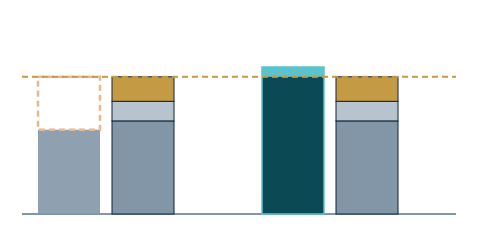
| Step | ₹ crore |
|---|---|
| Assets at book | 108.0 |
| Less operating payables and advances | −22.0 |
| Net operating assets at book (cash of 12.0, a float the halls need, is included) | 86.0 |
| Less financial claims (95.0 + 20.0 + 25.0) | −140.0 |
| Net worth on the books | −54.0 |
| Enterprise value on the cash flows (₹12.0 crore ÷ (12% − 4%)) | 150.0 |
| Less the same financial claims | −140.0 |
| Equity value (would be 22.0 if the cash were surplus) | 10.0 |
| Gap between the two: value the books do not show | 64.0 |
What the cash says
Assume attendance has returned to its level before the closures, that next year's EBITDA is ₹28 crore, and that ticket prices and food-counter spending grow 4% a year after that. Of the ₹28 crore, ₹8 crore is depreciation, leaving ₹20 crore of operating profit. Tax at 25% takes ₹5 crore, leaving ₹15 crore. Replacing screens, seats and projectors absorbs ₹10.5 crore of capital spending, and working capital another ₹0.5 crore, against the ₹8 crore of depreciation already deducted. What remains is ₹12 crore of free cash flow (cash available to all providers of capital), with a net reinvestment of ₹3 crore, which is 20% of the after-tax profit.
A business that grows 4% a year while earning 20% on each new rupee it invests must reinvest 4% ÷ 20%, or 20%, of its after-tax operating profit. At a discount rate of 12% for the business (an assumption, not an observed rate), EV is ₹12 crore ÷ (12% − 4%) = ₹150 crore, which is 5.4 times EBITDA. The ₹12 crore is next year's cash flow.
The tax saving on carried-forward losses is left out, and that favours the shareholders. With ₹112 crore of accumulated losses against tax of ₹5 crore a year, the saving could rival the whole ₹10 crore of equity computed below, depending on how much of the loss the tax law lets Sutradhar use and for how long.
Claims on that value are ₹95 crore of senior secured loans, ₹20 crore of an unsecured loan and ₹25 crore of preference shares: ₹140 crore in all. Operating payables and advances of ₹22 crore are working capital. So is the ₹12 crore of cash the halls need as a float: both sit inside the cash flows and neither is added to or taken from EV. Had the ₹12 crore been surplus, equity would be ₹22 crore. On the stated basis it is ₹150 crore minus ₹140 crore, or ₹10 crore.
Book net worth is minus ₹54 crore and equity value is plus ₹10 crore, so the books miss ₹64 crore of value. Net operating assets at book come to ₹86 crore (₹108 crore of assets, cash included, less ₹22 crore of payables) and the cash flows are worth ₹150 crore; the difference is earnings power that the balance sheet never recorded. It cannot be cleanly split between "land worth more than cost" and "relationships and location", because a cinema site and the audience that reaches it produce the same cash flow once.
Equity is a call option on the business
The ₹10 crore is a thin margin. EV only has to fall by less than 7% for it to vanish, and it vanishes if new capital earns 15.8% instead of 20% (EV is then exactly the claims) or if the discount rate is 13% instead of 12% (EV ₹133.3 crore). So what is the equity worth when value is uncertain?
A shareholder in a company limited by shares can lose no more than the unpaid amount on the shares (section 2(22)), which for fully paid shares is nothing further. If the business is worth less than the claims, the owners do not pay the difference; the lenders absorb it. The payoff to the equity at any EV is therefore the greater of zero and EV minus claims, the payoff of a call option whose strike is the total of the claims ahead of it. This is Merton's 1974 way of looking at the equity of a leveraged company.
Figure 2 shows who receives each additional rupee of value. The first ₹95 crore goes to the senior lenders, the next ₹20 crore to the unsecured lender, the next ₹25 crore to the preference holders, and only then does anything reach the equity.
Figure 2 · Hypothetical company
Where each extra rupee of value goes
View as a table
| Enterprise value | Senior | Unsecured | Pref. | Equity |
|---|---|---|---|---|
| 50 | 50.0 | 0.0 | 0.0 | 0.0 |
| 95 | 95.0 | 0.0 | 0.0 | 0.0 |
| 100 | 95.0 | 5.0 | 0.0 | 0.0 |
| 115 | 95.0 | 20.0 | 0.0 | 0.0 |
| 140 | 95.0 | 20.0 | 25.0 | 0.0 |
| 150 | 95.0 | 20.0 | 25.0 | 10.0 |
| 200 | 95.0 | 20.0 | 25.0 | 60.0 |
Three cases make this concrete. Suppose the low case is an EV of ₹100 crore (attendance stalls), the base case ₹150 crore and the high case ₹200 crore, with chances of 25%, 50% and 25%, assumed for illustration and averaging to the base case. In the low case the equity receives nothing, in the base case ₹10 crore, in the high case ₹60 crore. Weighted by the chances, that is ₹20 crore, against ₹10 crore for the equity at the average EV. The extra ₹10 crore is the option value: the equity gains in the high case what it can never lose below zero in the low case. It is an undiscounted, probability-weighted figure from three assumed cases, not a priced option.
The same exercise shows who holds the downside. The unsecured lender expects ₹16.25 crore on a ₹20 crore claim, 81% of face value, and the preference holders ₹18.75 crore on ₹25 crore, 75%. Together they expect ₹35 crore against ₹45 crore of face value, and that ₹10 crore shortfall is where the equity's extra value comes from. The senior lenders expect their full ₹95 crore, and the four expectations add up to ₹150 crore.
The calculator lets you set your own claims, your own book net worth and three cases of your own.
Calculator
Who gets what at each enterprise value
The defaults are Sutradhar’s. Enter your own claims in rank order, the net worth on your balance sheet, and three cases for enterprise value with a chance for each. Amounts are in ₹ crore. This is a teaching scenario, not a valuation.
Result
- Equity value, probability-weighted
- ₹20.0 crore
- Equity value at the base case
- ₹10.0 crore
- Option value inside it
- ₹10.0 crore
- Enterprise value needed before equity receives anything
- ₹140.0 crore
- Chance equity receives nothing
- 25%
- Base-case value the books do not show
- ₹64.0 crore
Senior secured claims
Face value ₹95.0 crore
- Low case
- ₹95.0 crore
- Base case
- ₹95.0 crore
- High case
- ₹95.0 crore
- Probability-weighted
- ₹95.0 crore (100% of face)
Unsecured claims
Face value ₹20.0 crore
- Low case
- ₹5.0 crore
- Base case
- ₹20.0 crore
- High case
- ₹20.0 crore
- Probability-weighted
- ₹16.25 crore (81% of face)
Preference shares
Face value ₹25.0 crore
- Low case
- ₹0.0 crore
- Base case
- ₹25.0 crore
- High case
- ₹25.0 crore
- Probability-weighted
- ₹18.75 crore (75% of face)
Equity
Whatever is left
- Low case
- ₹0.0 crore
- Base case
- ₹10.0 crore
- High case
- ₹60.0 crore
- Probability-weighted
- ₹20.0 crore
At the base-case enterprise value of ₹150.0 crore the equity is worth ₹10.0 crore. Weighting the three cases gives ₹20.0 crore, against ₹10.0 crore for the equity at the weighted-average value of ₹150.0 crore; the ₹10.0 crore between them is the option value. In the low case, the first claim not paid in full is the unsecured claims. This is a scenario weighting, not a price: it leaves out time, restructuring costs, tax and what the people running the company do while the outcome is open.
Several things are left out. The model has no time dimension: it does not say when the claims fall due or what accruing interest does to the option while a decision is awaited. It ignores tax and the costs of any restructuring. And it assumes the people running the business do not change what they do as the downside nears, a large assumption, because the owner of an option gains from variance and the lenders do not. A continuous option-pricing formula would need a volatility of EV that cannot be observed for an unlisted cinema chain, so three cases are used.
When the claims outrun the value
In the low case EV is ₹100 crore, ₹40 crore short of the claims. The senior lenders are untouched. The unsecured lender receives ₹5 crore of its ₹20 crore, and the preference holders and the equity receive nothing. The first claim not paid in full is the unsecured loan. Call that class the fulcrum, the place where value runs out. Here the unsecured lender economically owns the residual business, because every rupee above ₹95 crore goes to it until its claim is met.
A haircut is a creditor's agreement to take less than face value. Sutradhar's low case already contains an economic haircut of 75% on the unsecured loan, whatever the paper says. A restructuring can change the form and the allocation. A simple plan might convert the unsecured loan into 80% of the shares, leave 20% with the existing shareholders, and leave the senior loans in place.
| Holder | Strict order of claims | Conversion plan |
|---|---|---|
| Senior secured lenders | ₹95.0 crore | ₹95.0 crore |
| Unsecured lender | ₹5.0 crore | ₹4.0 crore, in shares |
| Preference shareholders | nil | nil |
| Existing shareholders | nil | ₹1.0 crore, in shares |
| Total | ₹100.0 crore | ₹100.0 crore |
The plan costs the unsecured lender ₹1 crore against its entitlement, and it is rational only if the promoter's staying adds at least ₹1 crore to the business, 1% of the ₹100 crore. It also pays the existing shareholders ₹1 crore while the preference holders, who rank ahead of them, receive nothing, so it works only if the fund agrees. It might, for the same reason the lender does: the promoter's staying keeps the business at ₹100 crore rather than less. A restructuring moves claims between holders; it cannot lift value above what the business is worth. Whether a plan raises the value itself, by keeping the halls open and the distributors dealing, belongs to the articles on valuing a business in distress.
When is value truly zero? When EV is below the claims with no realistic prospect of a case above them, the shares are worth nothing. If Sutradhar's low case were the only case, equity value would be nil with net worth still at minus ₹54 crore. The books cannot tell the two situations apart.
The four-layer order above is a model. In a liquidation under the Insolvency and Bankruptcy Code, 2016, section 53 sets a longer statutory order, with the costs of the process first, then workmen's dues and secured creditors who give up their security, and the preference shareholders and then the equity last; the article on liquidation value sets out every rung. Statutory and employee dues are assumed here to be paid as they fall due, which a liquidation would not allow.
Four questions that net worth does not answer
Negative net worth is not insolvency, and four different questions are in play.
| Test | What it asks, and what it looks at |
|---|---|
| Net worth | Have past losses exceeded the owners' funds? Looks at the audited balance sheet. |
| Value | Is EV above the claims ranked ahead of the equity? Looks at future cash flows and the queue of claims. |
| Cash | Can the company pay what falls due, when it falls due? Looks at cash, credit lines and maturities. |
| Default under the Code | Has a debt that is due and payable gone unpaid? Looks at a specific unpaid debt. |
Sutradhar passes the cash test only while attendance holds. A fall of 40% in EBITDA, from ₹28 crore to ₹16.8 crore, would cut interest cover from 2.3 times to 1.4 times, before any principal falls due.
The legal test is the last. Section 3(12) of the Insolvency and Bankruptcy Code defines default as non-payment of a debt when the whole or any part or instalment of it has become due and payable and is not paid. Section 4 applies the corporate insolvency part where the default is at least one lakh rupees, and lets the Central Government specify a higher minimum of up to one crore rupees; a notification of 24 March 2020 specified ₹1 crore. A company can have negative net worth and pay every instalment on time, as Sutradhar is assumed to do, and a company with positive net worth is in default the day it misses a payment that is due. The grounds on which the Tribunal may wind up a company under section 271 are a special resolution, acts against the interests of the State, fraud, five years of default in filing, and the just-and-equitable ground.
Net worth matters in contracts. Lenders' loan agreements commonly carry financial covenants, such as a minimum net worth or a ceiling on borrowings against it, and a company at minus ₹54 crore would normally be outside the first. How long it may carry on then depends on the lender's waiver. This describes common lending practice and is not sourced here.
Figure 3 · Hypothetical companies
Book net worth and value can point in different directions
Sutradhar, base case
Net worth −₹54 crore; enterprise value ₹150 crore against claims of ₹140 crore. Equity is worth ₹10 crore.
The ordinary case
Book and cash agree in sign. The owner’s attention goes to the size of the margin, not to its existence.
Sutradhar, low case
Net worth −₹54 crore; enterprise value ₹100 crore against ₹140 crore. Equity receives nothing in this case.
The mirror image
Assets at cost of ₹140 crore and liabilities of ₹110 crore give net worth of +₹30 crore, but the business is worth ₹90 crore. Positive book equity, no equity value.
View as a table
| Case | Book net worth | Value against claims |
|---|---|---|
| Sutradhar, base | −54 | 150 against 140: equity 10 |
| Sutradhar, low | −54 | 100 against 140: equity 0 |
| Ordinary case | positive | above the claims |
| Mirror image | +30 | 90 against 110: equity 0 |
The mirror image in the lower-right cell of Figure 3 is the useful warning. A company with positive net worth of ₹30 crore, whose business is worth ₹90 crore against ₹110 crore of claims, has no equity value at all. Its balance sheet looks safe because its assets were bought at a price the business can no longer justify.
The distance that matters
The conclusion that Sutradhar's shares are worth something reverses on a single fact. If attendance has not really returned to its earlier level, or new screens earn less than about 16% on the money put into them, base-case EV falls to the claims and the equity is nil, whatever the books say. A promoter in that position holds less than he thinks, and the party to bring a proposal to is whoever sits at the fulcrum in the low case, because that party decides whether the shares keep any value.
A promoter with a wide distance between EV and the last claim ahead of the shares negotiates from a different position, and the lenders can see it. Sutradhar's distance is ₹10 crore, about 7% of value, and which kind of promoter he is depends on the attendance figures, not on the balance sheet.
Talking it through
If a valuation question is in front of you, a conversation about purpose, scope and the information needed is usually the right first step.
Technical notes
- All amounts are in ₹ crore. The company, its 28 screens, the 12% discount rate, 4% growth, 20% return on new capital, the 25% tax rate, the three enterprise-value cases and their chances (25%, 50%, 25%) are assumed for illustration. None is an observed market figure.
- Scale check for the hypothetical company: revenue ₹140 crore and about 520 people (₹0.27 crore of revenue per person); EBITDA after rent ₹28 crore (20% of revenue); interest of about ₹12 crore (₹95 crore at an assumed 10% and ₹20 crore at an assumed 13%) so EBITDA covers interest 2.3 times (1.4 times if EBITDA fell 40%); senior claims 3.4 times EBITDA and all financial claims 5.0 times; enterprise value 5.4 times EBITDA. Rent is treated as an operating cost, so lease liabilities are not among the claims.
- Enterprise value = next year's free cash flow of ₹12.0 crore ÷ (12% − 4%) = ₹150.0 crore. Free cash flow = after-tax operating profit ₹15.0 crore × (1 − 4% ÷ 20%). Book net worth: share capital ₹40 crore + securities premium ₹18 crore − accumulated losses ₹112 crore = −₹54 crore (−₹29 crore if the ₹25 crore of redeemable preference shares were presented within share capital, a presentation not verified against Schedule III for this article). Net operating assets at book: ₹108 crore of assets − ₹22 crore of operating payables = ₹86 crore. The ₹12 crore of cash in those assets is treated as operating float inside the cash flows; if it were surplus, equity would be ₹22 crore and the gap to net worth ₹76 crore.
- Fragility of the base case: equity is nil if the return on new capital is 15.8% instead of 20% (EV = ₹140 crore) or if the discount rate is 13% instead of 12% (EV = ₹133.3 crore); EV need fall only 6.7% to remove the equity.
- Scenario results (₹ crore): low case EV 100 gives senior 95, unsecured 5, preference 0, equity 0; base case EV 150 gives 95, 20, 25, 10; high case EV 200 gives 95, 20, 25, 60. Probability-weighted: 95 + 16.25 + 18.75 + 20 = 150. Option value = 20 − 10 = 10, an undiscounted probability-weighted figure, not a priced option. Percentages of face are rounded to whole numbers (81.25% shown as 81%).
- Not modelled: the tax benefit of carried-forward losses (it would raise the equity and could rival the ₹10 crore), the date claims fall due and interest that accrues while a decision is awaited, other tax, costs of restructuring or liquidation, the possibility that management changes behaviour as the downside nears, statutory and employee dues beyond ordinary working capital, security over particular assets, covenant waivers, the consent of the preference holders to the conversion plan, and any effect of a plan on enterprise value itself. This is an educational model, not a valuation report.
References
Checked on 6 November 2026. Cited in general terms only.
- Companies Act, 2013: section 2(22) (company limited by shares), section 2(57) (net worth), section 68 (buy-back of securities) and section 271 (circumstances in which a company may be wound up by the Tribunal, as substituted with effect from 15 November 2016). Read from the India Code PDF of the Act. www.indiacode.nic.in
- Insolvency and Bankruptcy Code, 2016 (consolidated text up to 12 August 2021, as published by the Insolvency and Bankruptcy Board of India): section 3(12) (default), section 4 (application of Part II; minimum default) and section 53 (distribution of assets). The Insolvency and Bankruptcy Code (Amendment) Act, 2026 received assent on 6 April 2026; reports state that a specified list of its provisions came into force on 26 May 2026 (notification S.O. 2625(E)). The notification was not read for this article; check the Gazette before relying on a particular provision. The section 53 order is described as in the earlier consolidated text, and the Act's Explanations to section 53 are reported not to change the order. ibbi.gov.in
- Ministry of Corporate Affairs, notification S.O. 1205(E) of 24 March 2020 specifying ₹1 crore as the minimum amount of default under section 4. Confirmed from published commentary; the gazette text was not retrieved. www.scconline.com
- IFRS Foundation, IAS 38 Intangible Assets and IAS 32 Financial Instruments: Presentation (summary pages). Ind AS 38 and Ind AS 32 are the Indian converged standards; the Indian texts were not retrieved, and the treatment of redeemable preference shares under the earlier Indian standards was not verified. www.ifrs.org
- Merton, R. C. (1974), On the pricing of corporate debt: the risk structure of interest rates, Journal of Finance 29(2), 449–470 (cited from the bibliographic record; the paper was not re-read for this article).
About this article
This article and its illustrations are for general education. They are not a valuation, a valuation report under any law, or advice on any transaction, tax or regulatory matter.
A valuation for a real decision depends on the facts, the purpose, the date, the applicable law and standards, and the information available. Please seek professional advice before relying on any figure.
No cinema operator, lender or fund is described here; Sutradhar Cinemas Private Limited exists only in this arithmetic.