Article
Contents · 7 sections
Paying to find out
Splitting Harit Conductors in two would cost its shareholders ₹6 crore of one-off expense and then another ₹2.8 crore a year that never ends. Rohit Bansal, who sits on the board for the private equity fund that owns 24% of the company, wanted to know what that bought. He had read page two of the adviser’s note twice. “The parts are worth more than the whole,” he said. “That is what it says. So why does the draft scheme read as if we are paying to find out?”
Nobody at the table in Faridabad answered at once, because the draft did read that way. Harit Conductors Private Limited makes electrical cables and, for some years now, has also installed and maintained rooftop solar plants for factories. About 820 people work for the company, 41 of them in finance, HR, IT and legal roles that serve both businesses. The Rathee family holds 62%, the fund 24% and an employee trust 14%. Sandeep Rathee runs the cables and his sister Veena runs the solar side. The proposal is to demerge solar into a new company, Harit Solar Services, and give every shareholder shares in it. The company’s borrowings, net of cash, come to ₹120 crore and were taken jointly. The two businesses look like this, with every figure an assumption of this article.
| Cables | Solar services | |
|---|---|---|
| Sales | ₹380 crore | ₹150 crore |
| EBITDA (operating profit before depreciation, interest and tax) | ₹38 crore | ₹18 crore |
| Operating profit after tax, next year | ₹22.5 crore | ₹11.25 crore |
| Growth assumed from then on | 5% a year | 7% a year |
| Return on each new rupee invested | 15% | 18% |
| Discount rate inside the company | 11.5% | 14.0% |
Harit and everyone named here are constructed for this article. Every rupee figure is an assumption to be tested, not an observation.
Rohit’s question deserves a better answer than the adviser’s sentence, which is true only on conditions. This article puts a price on those conditions. In the model built here, the draft scheme as costed leaves the two companies worth ₹23 crore less than the one company is today, and the article shows which assumptions would have to change to reverse that. The remaining inputs are in the notes at the end.
What the ratio does
The first number everybody asks about is the share entitlement ratio: how many shares of the new company each holder receives for the shares held in the old one. In the draft it is one Harit Solar share for every four Harit Conductors shares, and Harit Conductors is assumed to have 1 crore shares in issue. Companies Act, 2013, section 232(2)(c), requires the directors to circulate a report explaining the effect of the scheme on each class of shareholders, “laying out in particular the share exchange ratio”, and the report goes to the meetings that the National Company Law Tribunal (the Tribunal) orders before it sanctions the scheme. A ratio is therefore a regulated number. It is not a value-creating one.
Figure 1 · Illustration with invented data
Three ratios, one holder, one total
View as a table
| Case | Solar shares per 100 held | Price of a Solar share | Value of both holdings (₹) |
|---|---|---|---|
| Today | none | none | 20,898 |
| One Solar share for every 1 held | 100 | ₹42.0 | 18,602 |
| One Solar share for every 4 held | 25 | ₹168.2 | 18,602 |
| One Solar share for every 10 held | 10 | ₹420.5 | 18,602 |
Whatever the ratio, a holder of 100 Harit Conductors shares ends with the same slice of both companies. The ratio sets how many pieces of paper the Solar slice is cut into. At one for one, a Solar share is worth ₹42.0 in this model; at one for four, ₹168.2; at one for ten, ₹420.5. A holder’s two holdings add up to the same ₹18,602 each time, about ₹2,300 below today’s ₹20,898. That fall comes from the economics that follow, and the ratio cannot touch it.
One condition makes the ratio harmless, and it comes from tax. Section 2(35) of the Income-tax Act, 2025, defines a demerger for the purposes of that Act. The transfer must be under a scheme under sections 230 to 232 of the Companies Act, of an undertaking as a going concern. Its property and liabilities must move at the values in the company’s books. The new company must issue its shares to the old company’s shareholders on a proportionate basis, and holders of at least three-fourths in value of the old company’s shares must become shareholders of the new one. The text read here is the Act as first published in the Gazette of India in August 2025. Later amendments, including those of the Finance Act 2026, were not checked, and the definition also allows for conditions notified by the Central Government. The proportionate-issue condition explains why the ratio cannot move wealth between holders: everyone ends up with the same mix. A scheme in which Veena’s branch took only the solar shares and Sandeep’s only the cables shares would be a split of owners, not a demerger of the kind defined above. There the ratio and the value of each piece would decide who gains.
Dividing the balance sheet
A sanctioned scheme moves the property, the liabilities and, if the order says so, the employees to the new company (section 232(3) and (4)). What matters is the list. Plant and receivables are easy. The harder entries are the bank guarantees that solar customers require, the supply contracts signed in the group’s name, the licences, the “Harit” name itself and the 41 shared employees.
Debt is the entry that tests the rest. The same section says which liabilities go with an undertaking: those arising from its operations, loans raised solely for it, and a share of general or multipurpose borrowings worked out as those borrowings multiplied by the value of the assets transferred and divided by the company’s total assets. Treat Harit’s ₹120 crore as general borrowings, net of cash for simplicity. Solar holds 30% of the book assets, so on that formula it takes ₹36 crore. Now ask what a lender would accept for each business on its own. Suppose, as an assumption, that cables could carry 2.5 times its EBITDA and solar 1.5 times. That is ₹95 crore and ₹27 crore. Lenders are parties to the scheme as well: an arrangement binds creditors only if a majority representing three-fourths in value of those voting approve it and the Tribunal sanctions it (section 230(6)).
Figure 2 · Illustration with invented data
Where the ₹120 crore of debt can go
View as a table
| Business | Debt on the asset formula (₹ crore) | Assumed limit (₹ crore) | Room (₹ crore) |
|---|---|---|---|
| Conductors | 84.0 | 95.0 | +11.0 |
| Solar Services | 36.0 | 27.0 | −9.0 |
| Together | 120.0 | 122.0 | +2.0 |
Cables fits with ₹11 crore to spare. Solar is ₹9 crore over its limit. The two limits together are ₹122 crore, ₹2 crore more than the debt today, so the debt could be placed by moving ₹9 crore from solar to cables, though a scheme that departs from the formula should be checked with a tax adviser, because what the departure would cost has not been established here. The margin is thin. Borrowing the ₹120 crore jointly meant that each business stood behind the other: when solar’s receipts slow, cable sales are there to pay the bank. After the split that backing ends, and each business is lent to on its own record. The sum of the parts’ debt capacity can be lower than the whole’s, and a sum of parts that cannot refinance its debt is worth less than the arithmetic says.
The bill before the benefit
Every demerger has a bill that arrives before any benefit. It has three lines.
The first is duplicated cost. Today the common functions cost ₹7.0 crore a year. After the split each company needs its own finance head, auditor, payroll, ERP licences and compliance staff, and the pool becomes ₹9.0 crore: ₹1.0 crore more in each company. Cost that remains behind because it was sized for two businesses and now serves one is called a stranded cost. The second is the loss of what size bought: shared insurance, freight and software terms, assumed at ₹0.3 crore for cables and ₹0.5 crore for solar. The third is one-off: advisers, the valuation report, Tribunal and filing costs, re-papering contracts and bank documents, and splitting systems, assumed at ₹6.0 crore.
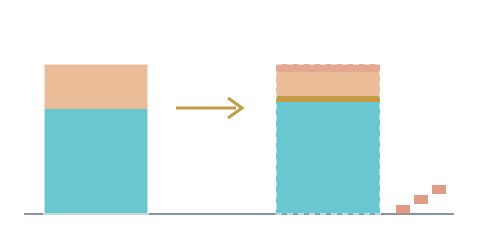
The recurring lines come to ₹2.8 crore a year before tax and ₹2.1 crore after tax at 25%. They grow with prices, assumed at 4% a year, and unlike a one-off they never end. Discounted at each company’s own rate, they are worth ₹24.3 crore. Add the ₹6.0 crore and the bill is ₹30.3 crore.
Figure 3 · Illustration with invented data
The bill, and the rate effects that partly offset it
View as a table
| Step | ₹ crore |
|---|---|
| Today’s company (enterprise value) | 329.0 |
| Conductors at its own, lower rate (11.5% to 11.1%) | +15.1 |
| Solar at its own, higher rate (14.0% to 14.6%) | −7.8 |
| Extra running cost, present value (13.7 + 10.6) | −24.3 |
| One-off cost | −6.0 |
| Two companies together | 306.0 |
| Difference from today’s company | −23.0 |
Against that bill sits the only benefit in the model so far, and it is an assumption. Today the company is valued as the sum of its two businesses, each at its own risk rate: 11.5% for cables and 14.0% for solar (the discount rate is the annual return investors require, and a lower rate gives a higher value). The two are lent to as one group, and solar’s bank guarantees on customer contracts are claims on the whole group’s balance sheet. Standing alone, cables would no longer stand behind those guarantees or carry solar’s project-execution risk, so a lender would price it on cable-sector risk alone, and its rate is assumed to fall to 11.1%. Solar loses the group’s balance sheet behind its guarantees and is smaller, so its rate is assumed to rise to 14.6%. The first change adds ₹15.1 crore and the second removes ₹7.8 crore, a net ₹7.3 crore in the scheme’s favour.
That net figure deserves suspicion. The two changes move risk from one half to the other, and unless the risk carried by the pair falls, cables’ gain would be largely matched by solar’s loss. The draft assumes cables gains more, and that is the claim a bank would have to confirm. Of the ₹23.0 crore shortfall, the bill accounts for ₹30.3 crore and the rate assumptions for ₹7.3 crore the other way; with no net rate benefit the shortfall would be about ₹30 crore. The result also turns on the rates themselves: a further 0.43 of a percentage point in the favourable direction on each standalone rate, to 10.7% for cables and 14.2% for solar, would close the gap.
What each half could do alone
The other benefit people mention is management focus. It is a hypothesis about particular decisions, and a hypothesis can be checked against the company’s own files. If solar is held back inside Harit, the evidence is a list of projects it proposed, the return each was expected to earn, the hurdle the group applied, and what happened. Call it the rationing register. Where good proposals were refused or deferred for want of cash that cables then spent at a lower return, the claim has a basis. Where the register is empty, the claim is a hope. Focus also costs something: the solar head will now spend days on bank covenants, audit and a board that cables used to supply.
Suppose the register does show rationing, and solar could grow at a higher rate on the same 18% return on new capital. The figure below gives the sum of the parts minus today’s value for different growth rates and different standalone rates for solar. At 7% growth and a 14.6% rate the answer is the −₹23.0 crore already seen. To pay for the bill at that rate, solar would have to grow at about 10.4% a year indefinitely instead of 7%, reinvesting 58 paise of every rupee of profit instead of 39 paise.
Figure 4 · Illustration with invented data
What Solar would have to do to pay for the split
| Growth | 14.0% | 14.6% | 15.2% |
|---|---|---|---|
| 7% | −15.8 | −23.0 | −29.0 |
| 8% | −9.9 | −18.7 | −26.1 |
| 9% | −1.6 | −13.0 | −22.1 |
| 10% | +10.9 | −4.7 | −16.7 |
| 11% | +31.8 | +8.1 | −8.7 |
That is a demanding claim. Read the grid by its shape: one more point of solar growth adds between ₹3 crore and ₹21 crore across the table, the larger gains coming where growth is already high, while a fall of 0.43 points in both rates adds ₹23 crore. Growth only helps when the return on new capital is above the rate, and a higher growth rate in a one-stage model is applied indefinitely, which flatters it. A buyer or a lender will want the register before accepting the growth.
Less than the whole, or more
The sum of the parts is lower than the whole when the split destroys something the whole had: scale, shared debt capacity, a single set of overheads. It is higher when the whole carried a drag that the pieces would not. There are three ways a drag arises. Cash may be rationed away from a division that earns more than its cost of capital. A weak unit may be subsidised by a strong one, so that neither is run for returns. Or an outsider may price a mixed group on one blended multiple (a price set as a multiple of profit), so that the faster-growing part is valued like the slower one. The last of these is what a conglomerate discount means as a mechanism: someone with a single yardstick prices a group of unlike businesses. For an unlisted company it shows up as a bidder’s offer, not as a share price. No number is attached to it here, because none comes from this model.
The explorer below runs both directions. Its defaults are the draft above. A button sets the “starved” case, in which solar grows at 4% inside the group and could grow at 9% alone. The whole is then worth ₹318.3 crore, and the parts after the bill are worth ₹316.0 crore, still ₹2.3 crore short. The second button also removes the size penalty on solar’s rate (14.0% instead of 14.6%), and the parts then come out ₹9.2 crore ahead. So the same company can show a loss and a gain depending on whether one rationing claim and one rate claim are evidenced, which is why each deserves its own paper trail.
Explorer
Does the split pay for itself?
The defaults are Harit’s draft scheme. Business A is the one that stays (cables); business B is the one that moves out (solar). Replace the figures with your own company’s. Amounts are in ₹ crore and rates in per cent. Tax is fixed at 25% and extra costs are assumed to grow 4% a year. This is an educational scenario, not a valuation.
Result
- Two companies minus today’s company
- −₹23.0 crore
- As a share of today’s value
- −7.0%
- Today’s company (enterprise value)
- ₹329.0 crore
- Two companies before the bill
- ₹336.4 crore
- Running cost, present value
- ₹24.3 crore
- Two companies after the bill
- ₹306.0 crore
- B’s growth that would close the gap
- 10.4% a year
- Fall in both rates that would close it
- 0.43 points
- Debt moving to A / B (₹ crore)
- 84.0 / 36.0
- Room under lender limit, A / B (₹ crore)
- +11.0 / −9.0
- Equity value of A / B after the split (₹ crore)
- 144.0 / 42.0
- Equity value today
- ₹209.0 crore
On these inputs the two companies are worth ₹23.0 crore less than today’s company. The answer rests on the assumed standalone rates, the growth B could reach alone and the cost of running two. It leaves out tax, stamp duty, customer reaction and timing.
The model is a simplification, and several things it leaves out matter in practice. It ignores stamp duty, GST and income tax on any step, which vary by state, scheme and facts. It does not model customers or staff who react to the split, or the time managers lose. Each business is a steady-growth perpetuity from next year, with no explicit forecast period. It applies no discount for the lower liquidity of shares in the smaller company. It treats debt capacity as a fixed multiple of EBITDA that the user supplies, which no lender will quote in advance. The explorer shows which assumption carries the answer and values no real company.
Cheaper doors
Rohit’s fund wants something specific, even if it said “value”. Perhaps it wants solar to borrow in its own name, to bring in an investor who wants solar only, or to let the family branches part. Each of these is a transaction that follows the demerger, and each may be reachable by a lighter route: a wholly-owned subsidiary with its own bank limits, a minority investor in that subsidiary, separate management accounts and a transfer-pricing agreement between the two businesses. Those routes have their own tax and stamp-duty effects, which are outside this article and need advice. For the family case, a demerger is the tool built for separating owners.
Before anyone pays the Tribunal fee, write down the second transaction that the demerger makes possible and name the party on the other side of it. Price that transaction with the demerger and without it. If the list is empty, the draft scheme costs about ₹30 crore in present value, set against a pair of discount-rate assumptions that no bank has yet confirmed. If the list names a party who has said in writing what it will pay, the comparison can turn the other way.
Talking it through
If a valuation question is in front of you, a conversation about purpose, scope and the information needed is usually the right first step.
Technical notes
- All amounts are in ₹ crore unless stated. The company, its two businesses, the discount rates (11.5% and 14.0% inside the whole; 11.1% and 14.6% alone), growth rates (5% and 7%), returns on new capital (15% and 18%), the extra yearly costs (₹1.3 crore and ₹1.5 crore), the ₹6.0 crore one-off cost, the debt limits (2.5 and 1.5 times EBITDA), the 30% asset share and the 62%/24%/14% shareholding are assumed for illustration. None is an observed market figure and none is a typical value.
- Inputs not shown in the text: depreciation ₹8 crore (cables) and ₹3 crore (solar), tax 25%, common-function pool ₹7.0 crore a year becoming ₹9.0 crore, 1 crore shares in issue, the ₹120 crore treated as general borrowings net of cash, and 30% of book assets moving with solar. Of the −₹23.0 crore result, the bill is −₹30.3 crore and the assumed standalone discount rates are +₹7.3 crore (+15.1 and −7.8); with no change in rates the shortfall would be about ₹30 crore. Those rate changes move risk between the two halves and have not been tested with any lender.
- Value of each business = next-year operating profit after tax × (1 − growth ÷ return on new capital) ÷ (discount rate − growth), that is, a steady-growth perpetuity with reinvestment consistent with growth. Today’s company is the sum of its two businesses, each at its own rate, so any difference after the split comes from the separation itself and not from a conglomerate discount. Extra running costs are taken after tax at 25%, grow 4% a year and are discounted at each company’s own standalone rate. The one-off cost is taken at face value, with no tax relief. Every figure was recomputed in verify_calcs.py by summing 3,000 years of discounted cash flows instead of using the closed form.
- Scale check for the invented company: sales ₹530 crore and about 820 people (₹0.65 crore of sales per person); EBITDA margins 10% (cables, a low-margin, metal-heavy business) and 12% (solar installation and service); EBITDA ₹56 crore; enterprise value ₹329.0 crore, 5.9 times EBITDA; net debt ₹120 crore, 2.1 times EBITDA, with operating profit covering interest at about 10% about 3.8 times; equity value ₹209.0 crore.
- Rounding: displayed parts reconcile to displayed totals (329.0 + 15.1 − 7.8 − 24.3 − 6.0 = 306.0; 13.7 + 10.6 = 24.3). The difference of −₹23.0 crore is −7.0% of today’s value. The fall in a 100-share holding (₹20,898 to ₹18,602) is shown in the text as about ₹2,300. The break-even growth of 10.4% and the break-even rate fall of 0.43 points are solved on the same model.
- Not modelled: stamp duty, GST and income tax on any step; the carry-forward of losses; customer, supplier and employee reactions; management time; any discount for lower liquidity of shares in the smaller company; a different tax shield on debt after the split; an explicit forecast period; and anything about a real company. This is an educational model, not a valuation report.
References
Checked on 6 November 2026. Cited in general terms only.
- Companies Act, 2013 (18 of 2013): section 230(6) (approval by a majority representing three-fourths in value of the members or creditors voting), section 232(1) to (4) and (6) (schemes involving a transfer to, or a division among, companies; the directors’ report on the share exchange ratio; transfer of property, liabilities and employees; the appointed date) and the Explanation to section 232 (meaning of a scheme involving a division). Read from the India Code copy of the Act. www.indiacode.nic.in
- Income-tax Act, 2025 (30 of 2025), section 2(35) and its Explanation (definition of demerger: scheme under sections 230 to 232 of the Companies Act, 2013; property and liabilities at book values; proportionate issue of shares; three-fourths in value; going concern; conditions notified under section 116(7); liabilities relatable to the undertaking, including general or multipurpose borrowings allocated as N = K x L/M). Read from the Gazette of India Extraordinary, Part II, Section 1, No. 35, 21 August 2025 (copy hosted by ICAI). Amendments after that date, including the Finance Act 2026, and the provisions granting relief that depend on this definition, were not read. resource.cdn.icai.org
About this article
This article and its illustrations are for general education. They are not a valuation, a valuation report under any law, or advice on any transaction, tax or regulatory matter.
A valuation for a real decision depends on the facts, the purpose, the date, the applicable law and standards, and the information available. Please seek professional advice before relying on any figure.
Harit Conductors, its owners and its board are a constructed case; the rupee figures and rates are assumptions chosen to be tested, and no real scheme is reported.